
How We Grew a Client’s Website Traffic 26% With SEO + AI Search (2026 Case Study)
By Christopher Eshnaur, Creative Director at Draft Creative
The Results at a Glance
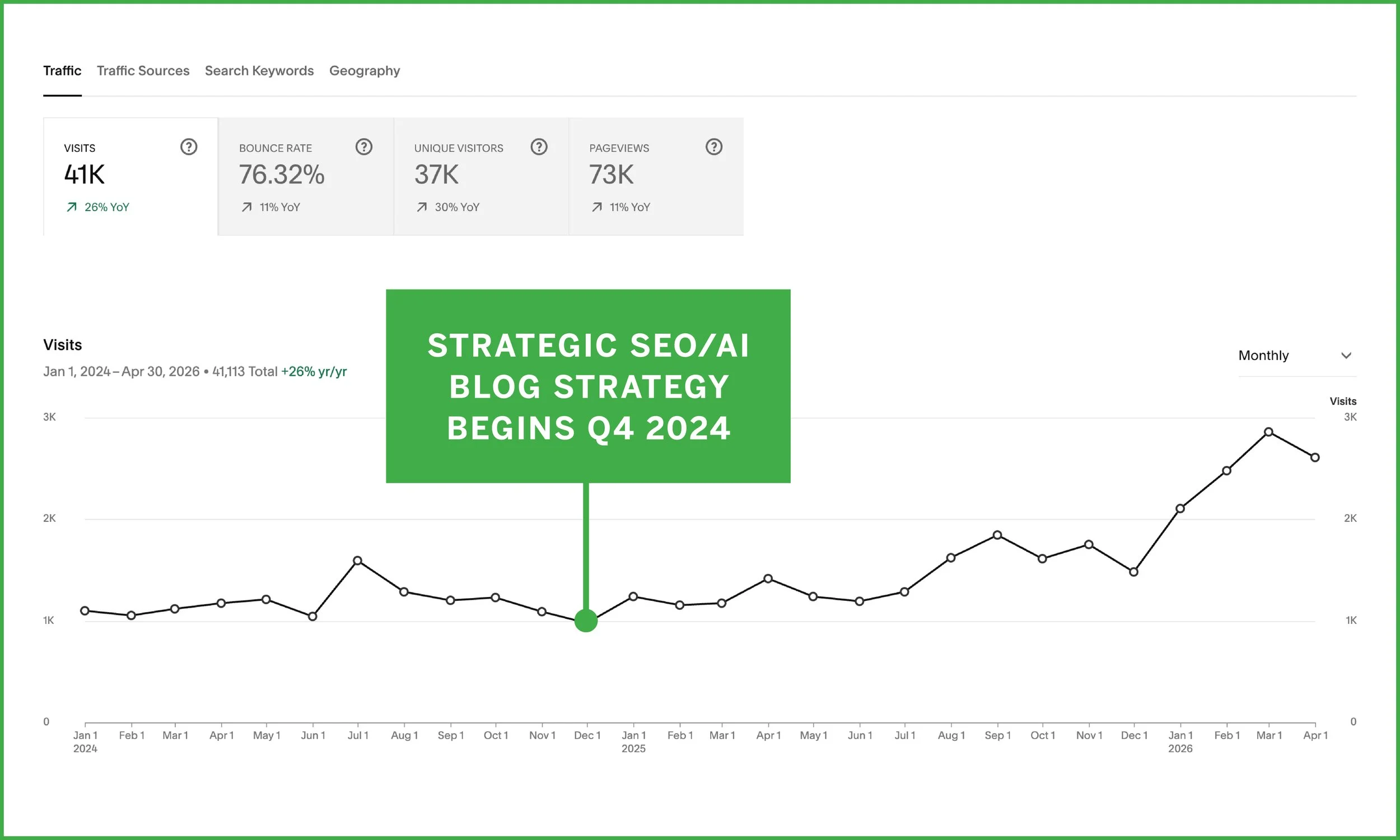
Between January 2024 and April 2026, a mid-size commercial and industrial real estate brokerage in Southern California grew its website traffic substantially after Draft Creative launched a strategic SEO and AI-search content program in Q4 2024:
41,113 total visits over the tracked period — up 26% year over year.
37,000 unique visitors — up 30% year over year.
73,000 pageviews — up 11% year over year.
Nearly 3x growth in monthly visits — from a flat baseline of around 1,000 per month through 2024 to almost 3,000 at peak by early 2026.
The chart above shows the shift clearly — traffic held flat through 2024, then began a sustained climb right after the content strategy launched in Q4 2024.
The Challenge
Through 2024, organic traffic for a mid-size commercial and industrial real estate brokerage in Southern California was flat — hovering around 1,000 visits a month, with the occasional one-off spike that never held. The site wasn’t losing ground, but it wasn’t compounding either: content was published without a clear search or AI-discovery strategy behind it, so each piece worked in isolation and none built lasting visibility.
What We Did: A Structured SEO + AI Search Content Strategy
Starting in Q4 2024, we replaced ad-hoc publishing with a deliberate content system built to perform in both traditional search and AI answer engines (GEO — Generative Engine Optimization). The core moves:
Question-based content mapped to real queries — we built pages around the exact questions the brokerage’s audience — investors, tenants, and developers — actually search, each opening with a clear, quotable answer that both readers and AI engines can extract.
Topic clusters, not one-off posts — related pieces were published and interlinked as clusters, so authority compounded across the site instead of sitting in isolated posts.
Sourced, specific content — claims were backed with real data and citations. This is a proven driver of AI visibility: Princeton-led research at KDD 2024 found that adding statistics, citations, and attributed quotes can lift visibility in AI answers by up to 40%.
Structured for machines — clean heading hierarchy, FAQ sections, and schema markup (FAQPage, Article, LocalBusiness) so search and AI systems could parse and cite the content reliably.
Consistent cadence — a steady publishing rhythm that let the cluster reach the critical mass where SEO and AI visibility start to compound.
The Results
Traffic didn’t just tick up. From a flat baseline of around 1,000 visits a month, monthly traffic grew nearly 3x — to almost 3,000 — with the steepest gains in the most recent months as the strategy compounds. Measured year over year, total traffic is up 26%, with unique visitors up 30%. (The two figures describe different things: the ~3x is the growth in monthly visits from the 2024 baseline to peak; the 26% is the year-over-year change in total traffic.)
A note on how we read this: the chart shows a clear correlation between the content program and the traffic climb, and the timing lines up closely with the Q4 2024 launch. We’d be the first to say a single strategy is never the only factor in a real business — seasonality, market conditions, and the client’s other efforts all play a part. But the pattern — flat before, sustained compounding growth after — is exactly what a well-executed SEO and AI-search content system is designed to produce.
What Made It Work — and What You Can Take From It
The transferable lessons, whether you run this in-house or with a partner:
Strategy beats volume. The client wasn’t publishing nothing before — they were publishing without a system. The change was direction, not just output.
SEO and AI visibility are one effort now. The same structured, sourced, question-led content that ranks on Google is what AI engines cite. You don’t choose between them.
It compounds, so it rewards starting early. The steepest growth came 6–12 months in. The cost of waiting is that a competitor builds that compounding advantage first.
Where Does Your Business Stand?
This client’s growth started with a clear-eyed look at where they were. If you don’t know whether your business is showing up in search and AI answers today, that’s the place to start. Draft Creative’s free AI Visibility Score checks how your business appears across AI assistants and where your gaps are — in about a minute.
The behavior behind results like these is only accelerating: AI-referred web traffic grew 527% year over year in one 2025 benchmark, reported by Search Engine Land. The businesses that build structured, AI-ready content now are the ones that compound.
Frequently Asked Questions (FAQ)
Q: How long did it take to see results?
A: Traffic began climbing within a few months of launching the content strategy in Q4 2024, with the steepest growth coming about 6 to 12 months in. SEO and AI-search content compounds over time rather than spiking immediately.
Q: Did the content strategy alone cause the growth?
A: The content program correlates closely with the traffic climb and the timing lines up with its Q4 2024 launch, but no single strategy is ever the only factor - seasonality, market conditions, and the client's other efforts contribute too. The pattern of flat-before, compounding-after is what a well-run SEO and AI-search system is designed to produce.
Q: Is this SEO or AI search optimization?
A: Both, and increasingly they are one effort. The same structured, sourced, question-led content that ranks on Google is what AI answer engines cite, so a modern content strategy targets both at once.
Q: Can any business get results like this?
A: Results vary by market, starting point, and execution, so this is one client's outcome, not a guarantee. But the underlying approach - structured, sourced content published in clusters and optimized for search and AI - applies broadly across industries.
About the Author
Christopher Eshnaur is Creative Director at Draft Creative, where he leads brand, content, and AI-search strategy for real estate and financial-services clients, including engagements with JLL and Houlihan Lokey. He works at the intersection of regulated-finance messaging, conversion-focused web design, and Generative Engine Optimization (GEO), helping mortgage and real estate brands get found by borrowers — and cited by AI answer engines.
Connect: LinkedIn →